,
2D Motion : Projectiles
 

[components] [time of flight] [max.height] [range] [velocity]


  • a drop-down menu of resources for 'empty.'
  • Vertical & horizontal components of velocity

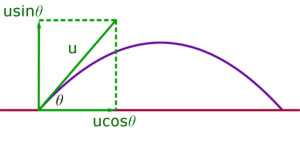
    When a particle is projected under gravity at a velocity u at an angle θ to the horizontal(neglecting air resistance)it follows the curve of a parabola.

    components of velocity

    The particle has an initial horizontal speed of ucosθ, which is unchanged throughout the motion.

    Vertically the particle has an initial speed of usinθ. It falls under gravity and is accelerated downwards with an acceleration of g ms-1,where g = 9.8 ms-2 (approx.)


    back to top


    Time of flight

    The time of flight is calculated from the vertical component of the velocity. It is the time it takes for the particle to go up, reach its maximum height and come down again. So this is twice the time to maximum height.

    If the time to maximum height is t secs. Then the time of flight is 2t.

    Consider motion up to maximum height. This is attained when the final velocity v = 0.
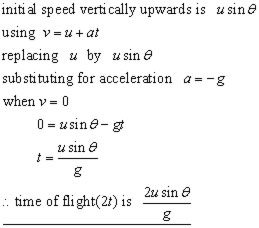
    equation for time of flight


    back to top


    Maximum height attained (H)

    The maximum height attained occurs when the particle is momentarily stationary, before falling under gravity. The vertical component of speed is zero at this point(v=0).
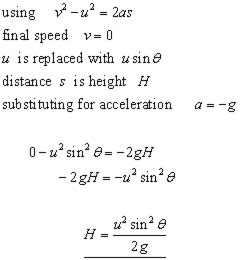
    projectile height equation


    back to top


    Range(R)

    The range is simply the horizontal component of speed multiplied by the time of flight.

    range of a projectile


    back to top


    Velocity(speed & direction) at time t

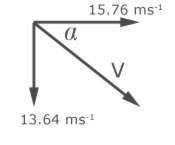
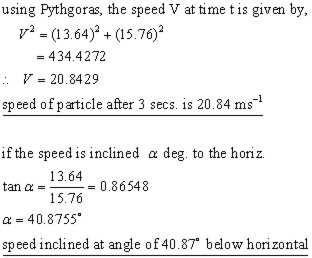
    Solution of problems is to find the vertical component of speed at time t and combine this with the original horizontal component of speed, which remains unchanged.

    Example
    A particle P is projected at an angle of 45 degrees to the horizontal at a speed of 30 ms-1 .
    What is the speed and direction of the particle after 3 secs.?
    (g=9.8 ms-2)
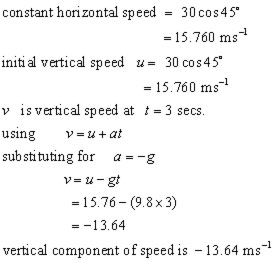
    projectile  vector problem #1a

    projectiles problem#1 diagram

    projectile velocity problem#01b


    back to top


    science 1701
    NEW BLOG & PODCAST
    to boldly go where science
    & maths may take us

    [ MECHANICS ][MATTER][ NUCLEAR ][ QUANTUM ][ ELECTRICITY ][ THERMAL PHYSICS ][ WAVE MOTION ][ FIELDS ]

    E-BOOKS(.pdf)

     
    Linear Motion
    2D Motion
    Kinetics
    Momentum, Impulse
    Statics


    VIDEO

    Newton's Laws
    equations of motion
    resolving a vector
    simple harmonic motion
    body on slope
    lawn mower problem


    Google Books

    (free book extracts)
     
    A-level Physics by Roger Muncaster
    A-level Physics
     
    Calculations for A-level Physics by Lowe & Rounce
    Calc. for A-level Phys.


    EXAM PAPERS(.pdf)

    (Edexcel)
     
    mechs. & rad. S2006 Q
    mechs. & rad. S2006 A
    mechs. & rad. W2007 Q
    mechs. & rad. W2007 A
    mechs. & rad. S2007 Q
    mechs. & rad. S2007 A
    mechs. & rad. W2008 Q
    mechs. & rad. W2008 A
    mechs. & rad. S2008 Q
    mechs. & rad. S2008 A


    PayPal - eBay's service to make fast, easy and secure payments for your eBay purchases.

    get adobe reader here

    get flash player here

    Documents