Linear Motion : Simple Harmonic Motion
 

[ theory ][ related to circular motion ]


  • a drop-down menu of resources for 'empty.'
  • Theory

    A particle is said to move with S.H.M when the acceleration of the particle about a fixed point is proportional to its displacement but opposite in direction.
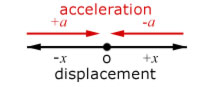
    SHM diagram

    Hence, when the displacement is positive the acceleration is negative(and vice versa).

    This can be described by the equation:

    SHM equation

    where x is the displacement about a fixed point O(positive to the right, negative to the left), and w2 is a positive constant.

    An equation for velocity is obtained using the expression for acceleration in terms of velocity and rate of change of velocity with respect to displacement(see 'non-uniform acceleration').

    acceleration - v dv by dx

    separating the variable and integrating,
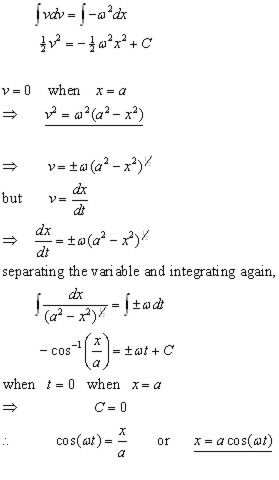
    SHM equation derivations

    NB cos-1() is the same as arc cos()

    So the displacement against time is a cosine curve. This means that at the end of one completete cycle,
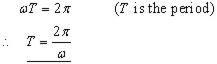
    period equation derivation

    Example

    A particle displaying SHM moves in a straight line between extreme positions A & B and passes through a mid-position O.

    If the distance AB=10 m and the max. speed of the particle is 15 m-1 find the period of the motion to 1 decimal place.
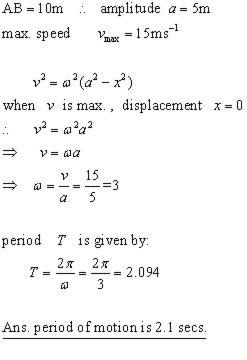
    shm problem #1


    back to top


    SHM and Circular Motion

    shm and the circle

    The SHM-circle connection is used to solve problems concerning the time interval between particle positions.

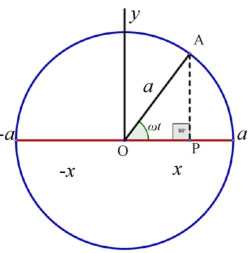
    To prove how SHM is derived from circular motion we must first draw a circle of radius 'a'(max. displacement).

    Then, the projection(x-coord.) of a particle A is made on the diameter along the x-axis. This projection, as the particle moves around the circle, is the SHM displacement about O.
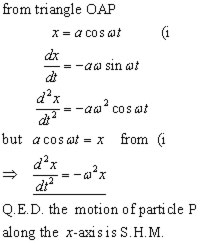
    shm circle proof

    Example

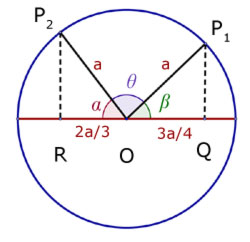
    A particle P moving with SHM about a centre O, has period T and amplitude a .

    Q is a point 3a/4 from O. R is a point 2a/3 from O.What is the time interval(in terms of T) for P to move directly from Q to R? Answer to 2 d.p.

    shm-circle problems #1

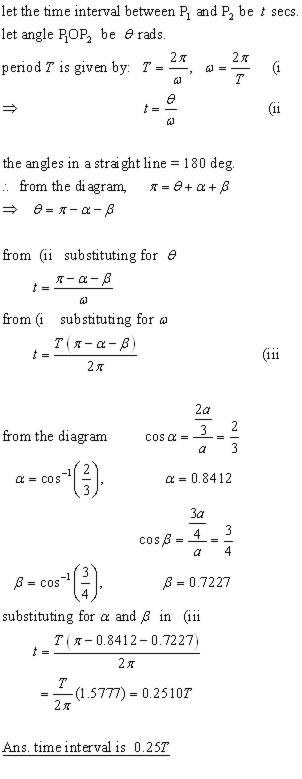
    shm-circle problem #1 answer


    back to top


    science 1701
    NEW BLOG & PODCAST
    to boldly go where science
    & maths may take us

    [ MECHANICS ][MATTER][ NUCLEAR ][ QUANTUM ][ ELECTRICITY ][ THERMAL PHYSICS ][ WAVE MOTION ][ FIELDS ]

    E-BOOKS(.pdf)

     
    Linear Motion
    2D Motion
    Kinetics
    Momentum, Impulse
    Statics


    VIDEO

    Newton's Laws
    equations of motion
    resolving a vector
    simple harmonic motion
    body on slope
    lawn mower problem


    Google Books

    (free book extracts)
     
    A-level Physics by Roger Muncaster
    A-level Physics
     
    Calculations for A-level Physics by Lowe & Rounce
    Calc. for A-level Phys.


    EXAM PAPERS(.pdf)

    (Edexcel)
     
    mechs. & rad. S2006 Q
    mechs. & rad. S2006 A
    mechs. & rad. W2007 Q
    mechs. & rad. W2007 A
    mechs. & rad. S2007 Q
    mechs. & rad. S2007 A
    mechs. & rad. W2008 Q
    mechs. & rad. W2008 A
    mechs. & rad. S2008 Q
    mechs. & rad. S2008 A


    PayPal - eBay's service to make fast, easy and secure payments for your eBay purchases.

    get adobe reader here

    get flash player here

    Documents