
Home >> Mechanics, kinetics, work & energy
work & energy |
Theory - Work & Energy
Consider a particle of mass m moving linearly with an applied force F constantly acting on it.
u = initial speed, v = final speed, a = acceleration,
s = distance covered, t = time taken
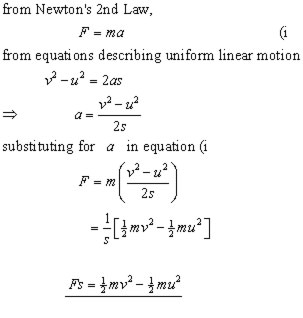
By definition,
work done = (force) x (distance force moves)
Since the expression ½mv2 is defined as the kinetic energy of a particle of mass m, speed v, our definition is modified to:
work done = change in kinetic energy produced
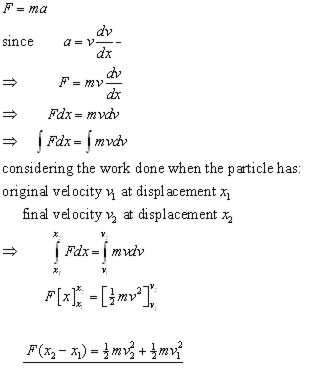
mathematical proof
Consider a particle, mass m, speed v, being moved along the x-axis by a force of magnitude F.
The applied force F is proportional to the displacement of the particle x, along the x-axis.
Gravitational Potential Energy
This is the energy a mass posesses by virtue of its position. It is equal to the product of mass, gravitational field strength(g) and the vertical distance the particle is above a fixed level.
m = mass speed(ms-1), g = gravitational field strength(N/kg)
h = vertical distance(m)
potential energy P.E.(joules) = mgh
(note the unit for g - the gravitational force on a mass of 1kg)
The Law of Conservation of Energy
In a closed system the amount of energy is constant. Or in other words 'energy can never be created nor destroyed', it mearly changes from one form into another.
This is the classical physics view that is useful for most purposes. However, in the real world systems are seldom perfect. We also have the problem when referring to particle physics that energy can indeed be created and destroyed. Annihilation of elementary particles is an example of this(matter-antimatter: electron-positron collision).
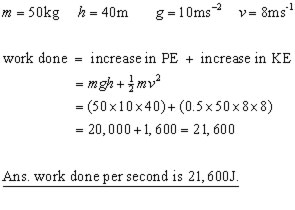
Example #1
A pump forces up water at a speed of 8ms-1 from a well into a reservoir at a rate of 50 kg s-1 .
If the water is raised a vertical height of 40 m, what is the work done per second?
(assume g=10 ms-2 )
Example #2
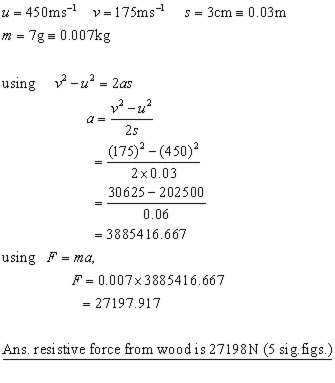
A gun is fired at a 3 cm thick solid wooden door.
The bullet, of mass 7g, travels through the door and has its speed reduced from 450 ms-1 to 175 ms-1.
Assuming uniform resistance, what is the force of the wood on the bullet?
(answer to 5 sig. figs.)
Example #3
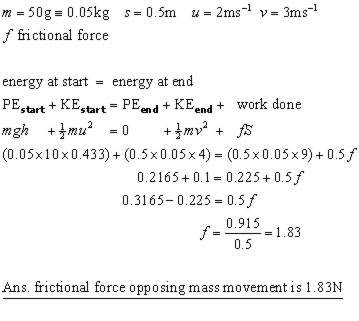
In a science experiment, a 50g mass slides down a 60o incline of length 0.5m.
If the mass is given an initial speed of 2 ms-1 down the plane and its final speed is measured as 3 ms-1, what is the magnitude of the frictional force opposing the mass?
(assume g=10 ms-2 , answer to 2d.p.)

this week's promoted video
[ About ] [ FAQ ] [ Links ] [ Terms & Conditions ] [ Privacy ] [ Site Map ] [ Contact ]