
Home >> Optics, microscopes
magnifying glass |
Magnifying Glass/Simple Microscope (image at Near Point)
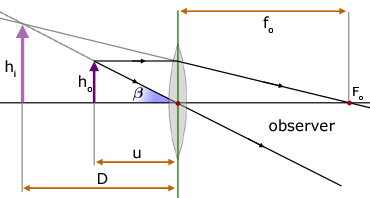
D is the Near Point of the eye. This is the closest an object can be to the eye and remain in focus.
By definition, magnification M is the height of the image hi divided by the height of the object ho :

From the diagram, the angle β (beta) is given by:

rearranging,
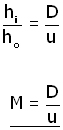
If we now use the lens equation:

In this case, v = - D . The image is virtual. So the sign is negative.
Hence,

Multipling both sides by D, and taking the second term over to the right,
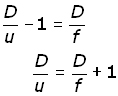
From our derivation of magnification M (above),

therefore our equation becomes,

With the image at the near point, the magnification of an object by a magnifying glass can be simplified as:

where f is measured in centimetres(cm)
Compound microscope
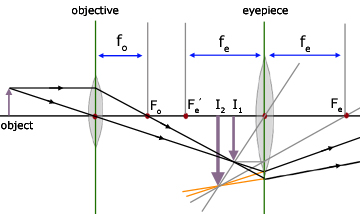
A microscope is very similar in arrangement to a telescope, the difference being in the focal length of the objective lens.
Microscope lens focal lengths are measured in mm, while telescope focal lengths can be measured in metres.
Essentially a real image is formed by the objective and this in turn is magnified by the eyepiece to form a virtual, erect image.
The first image (I1) is positioned infront of the eyepiece, between f and the lens. The eyepiece produces the virtual image (I2) behind the first image.
For the second image to be in focus, the distance between it and the eye must be at least 25 cm (D).
The magnifying power of a microscope is the product of the eyepiece and objective lens magnification.
[ About ] [ FAQ ] [ Links ] [ Terms & Conditions ] [ Privacy ] [ Site Map ] [ Contact ]